
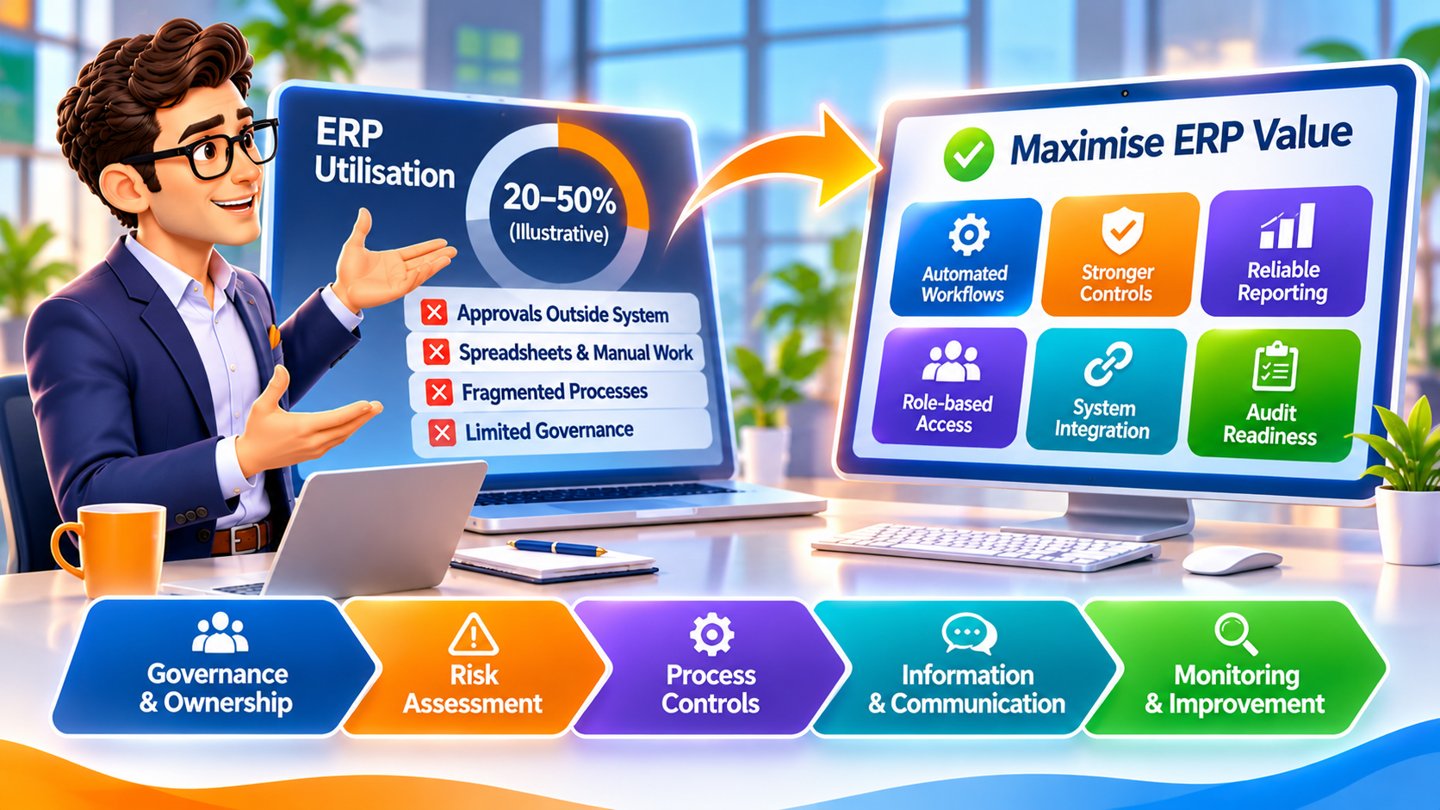
The biggest ERP failure is not always a failed implementation. It can be a successful go-live followed by years of underutilisation.
Businesses invest in NetSuite, SAP, Microsoft Dynamics and other ERP platforms expecting automation, reliable reporting and stronger governance. Yet approvals often remain in email, management reports in disconnected spreadsheets and important decisions outside approved workflows.
The issue isn't simply unused features. It's critical processes that the organisation has never properly integrated or controlled.
Why does ERP utilisation remain limited?
1. Go-live becomes the finish line. Implementations prioritise migrating data, processing transactions and closing the accounts. Approval rules, exception monitoring, access reviews and advanced reporting may be postponed indefinitely.
2. Managers prioritise delivery over system discipline. An email approval can appear faster than a configured workflow. But if the authorisation is not traceable or checked against policy, the organisation may record a transaction without adequately controlling it.
3. Training focuses on data entry. Users learn how to post invoices and journals but not necessarily how to operate exception queues, automate approvals or use built-in controls. Workarounds become normal.
4. Nobody owns continuous improvement. Finance, IT and operations each own part of the process. Without an accountable end-to-end owner, adoption gaps and unnecessary manual work persist.
Connecting ERP adoption with COSO, ACCA and ACA
The COSO Internal Control—Integrated Framework highlights five interconnected components: control environment, risk assessment, control activities, information and communication, and monitoring activities. ERP workflows can help apply these principles through defined approval authority, segregation of duties, accurate information and ongoing exception reviews.
ACCA's guidance on understanding business risks and IT controls explains how IT can strengthen consistent rules, information quality and segregation of duties—but only when appropriate controls and monitoring support the technology.
The ICAEW ACA syllabus also covers business processes, information flows, IT controls, governance and risk. These are management responsibilities, not merely technical configuration tasks.
For example, Oracle NetSuite's SuiteFlow approval workflows support approval routing. But buying the software alone does not mean the workflow has been configured, tested or adopted.
The better approach: measure ERP maturity, not feature counts
Ask five practical questions:
- Are critical approvals authorised and traceable?
- Are permissions and conflicting duties regularly reviewed?
- Can management rely on reconciled, timely reporting?
- Are manual workarounds controlled and justified?
- Is someone responsible for continuously improving adoption?
External tools and spreadsheets are not inherently wrong. They become a problem when information is fragmented, approval evidence is missing or controls cannot be demonstrated.
The objective is not 100% feature utilisation. It is effective governance over 100% of the critical processes the business chooses to operate.
A mature ERP should do more than record transactions. It should support accountable decisions, efficient workflows, reliable information and a stronger control environment.
ACE Analytics | Business Systems Consulting
Banner note: The 20–50% utilisation illustration is a hypothetical example, not a verified industry statistic.
.....................................