
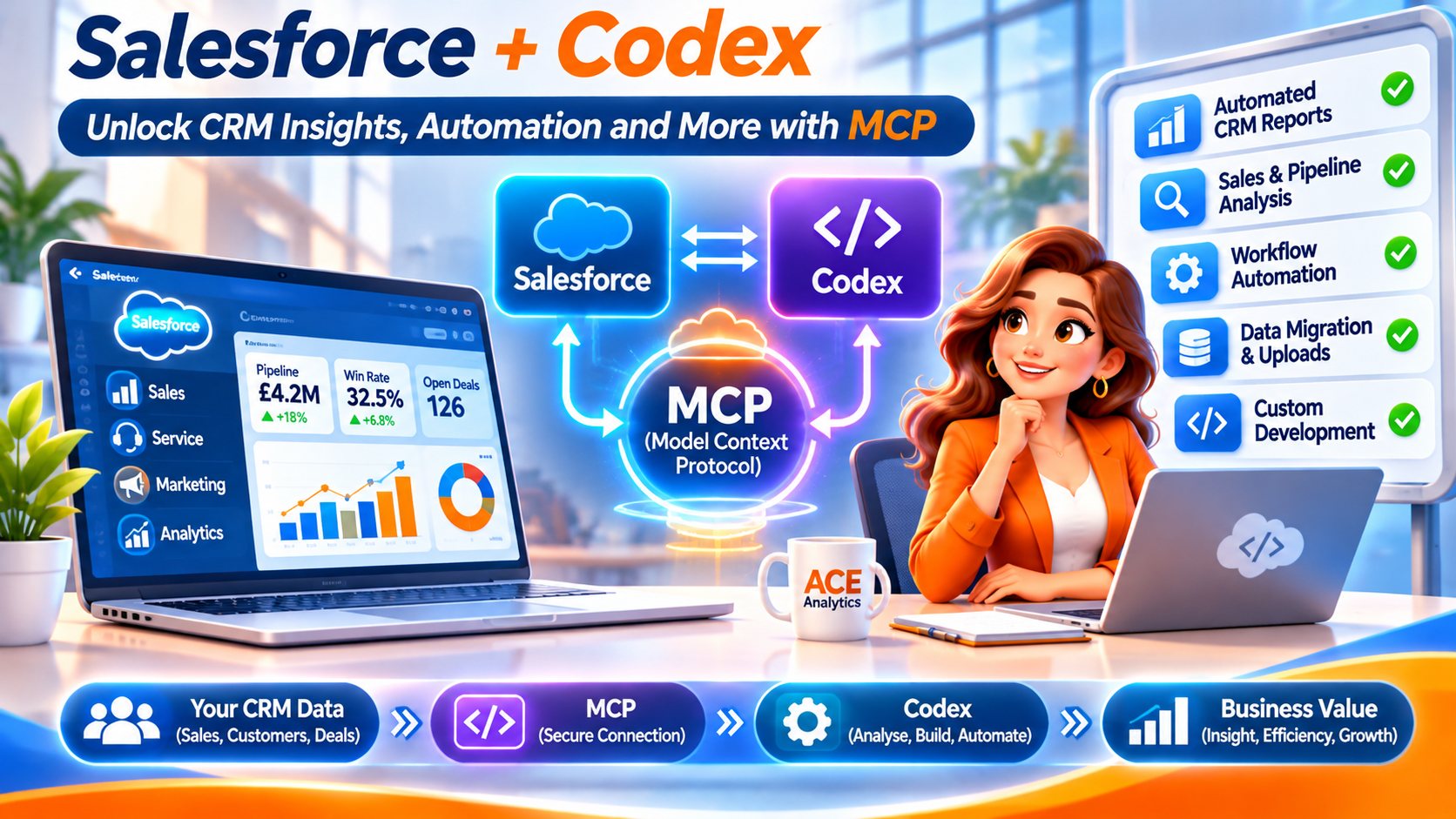
What if your sales team could analyse thousands of opportunities, identify lost revenue and automate repetitive CRM work by describing what they need?
Salesforce helps organisations manage customer relationships, opportunities, sales forecasts, marketing and service. Yet turning CRM data into timely insight can still require specialist reports, development work, spreadsheet exports and outside consultants. When information arrives late, commercial opportunities can be lost.
Why Salesforce reporting becomes expensive
Salesforce includes native reporting, dashboards, Flow automation and APIs. But complex requirements—such as cross-object analysis, tailored forecasting and custom integrations—often demand technical expertise. Development costs grow, business users wait for changes and some requests remain unresolved.
The opportunity is not to replace Salesforce. It is to unlock more value from the information already held in it.
What is MCP, and how does Salesforce connect with Codex?
Model Context Protocol (MCP) is an open standard that allows an AI client to use approved external tools. Salesforce provides hosted MCP capabilities, while OpenAI Codex can use MCP tools and assist developers in building, testing and maintaining connected Salesforce applications.
A typical flow is:
Business request → Codex or a custom AI application → authorised MCP tools → Salesforce records and workflows → validated output.
This is not unrestricted CRM access. The server's capabilities, OAuth authentication, Salesforce permission sets and available tools determine what can be read or changed.
Codex is primarily a software development agent, not an out-of-the-box sales analyst. An employee-facing conversational CRM assistant may require a custom application or additional orchestration.
How Salesforce users can benefit
Sales managers can investigate stalled opportunities, compare pipeline conversion by region and identify patterns in lost deals without manually collating multiple exports.
Commercial and finance teams can examine historical opportunity performance, forecast trends and customer concentration to support decisions.
Customer service teams can analyse case backlogs, issue categories and response performance from authorised records.
CRM administrators and developers can use Codex to assist with Apex, Lightning components, validation logic, Salesforce Flow and integration code.
Depending on configuration, businesses can also use authorised tools to prepare CRM data migrations, validate duplicate records, build custom dashboards and create or update supported accounts, contacts or opportunities.
Recurring reports can be refreshed from Salesforce data, but unattended scheduling and delivery require an automation service. Data-changing actions need explicit permissions and appropriate approvals.
What is required to activate it?
Salesforce administrators must select the appropriate approach, such as Salesforce Hosted MCP Servers for approved CRM data and actions or the Salesforce DX MCP Server for developer workflows.
Configuration may involve API access, OAuth credentials, connected applications, object and field permissions, MCP client settings and auditing. Each employee should use their own identity and assigned CRM privileges.
The same integration infrastructure can support multiple authorised people, but that does not mean all users see the same data or may perform the same actions.
Claude, Codex and API development
MCP is not restricted to one AI provider. A compatible assistant can use permitted MCP tools, while developers may combine the OpenAI API with Codex-assisted engineering to create tailored applications, reports and automations.
Salesforce licensing, API limits, development, AI usage and ongoing support costs may still apply. MCP alone does not replace every reporting add-on or eliminate the need for experienced CRM specialists.
What changes for the business?
Salesforce remains the system of record. AI can make its data easier to interpret and its approved workflows easier to extend. The value is faster analysis, fewer repetitive manual tasks and more timely commercial decisions—with governance preserved.
Need help setting it up?
Need our help to connect Salesforce with Codex or build a secure MCP integration for your team?
ACE Analytics can assess your CRM environment, configure permission-controlled integrations, develop dashboards and automations, and help users turn reporting requirements into working tools.
Discuss your Salesforce integration with ACE Analytics
Sources and further reading
Salesforce — Hosted MCP Servers
Salesforce — REST API and supported editions
OpenAI — Model Context Protocol
.....................................