AI should understand your business data — not have unrestricted access to it.
The Model Context Protocol (MCP) is changing how AI applications interact with SQL databases. From financial reporting to operational analytics, MCP can help assistants retrieve information and support quicker decisions. But a direct connection to sensitive data creates risk.
The Security Layer: Where Control Matters
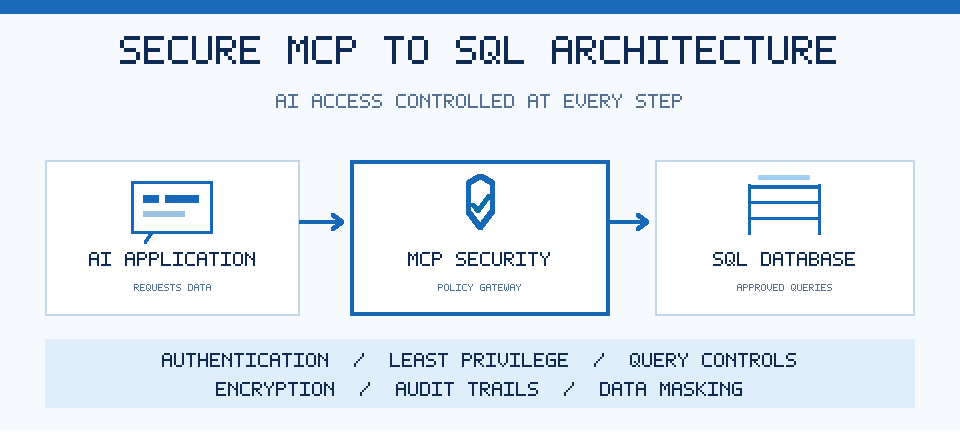
A secure design places enforced controls between the AI application, MCP tools and the database:
- Authentication and authorisation: Verify the user, validate tokens and enforce permissions for each tool and data request.
- Read-only by default: Use least-privilege SQL accounts and explicitly separate any approved write operations.
- Query validation: Prefer predefined, parameterised queries; never allow unrestricted AI-generated SQL execution.
- Data protection: Encrypt connections and restrict rows, columns and sensitive fields according to business need.
- Audit trails: Log tool calls and access decisions while redacting secrets and personal data.
Security Must Be Built Into the Architecture
MCP is a protocol, not an automatic security boundary. Prompt injection, over-privileged credentials and uncontrolled tools can put confidential information at risk. Technical safeguards must be enforced in trusted application and database code—not left to an AI prompt.
Give AI the information it needs, not unrestricted control over the database.
ACE Analytics | Secure Integration. Controlled Access. Trusted Intelligence.
References
- Model Context Protocol — Authorization specification: official technical requirements for protected MCP servers and access tokens.
- OWASP MCP Security Cheat Sheet: guidance on least privilege, tool security, input validation and monitoring.
.....................................