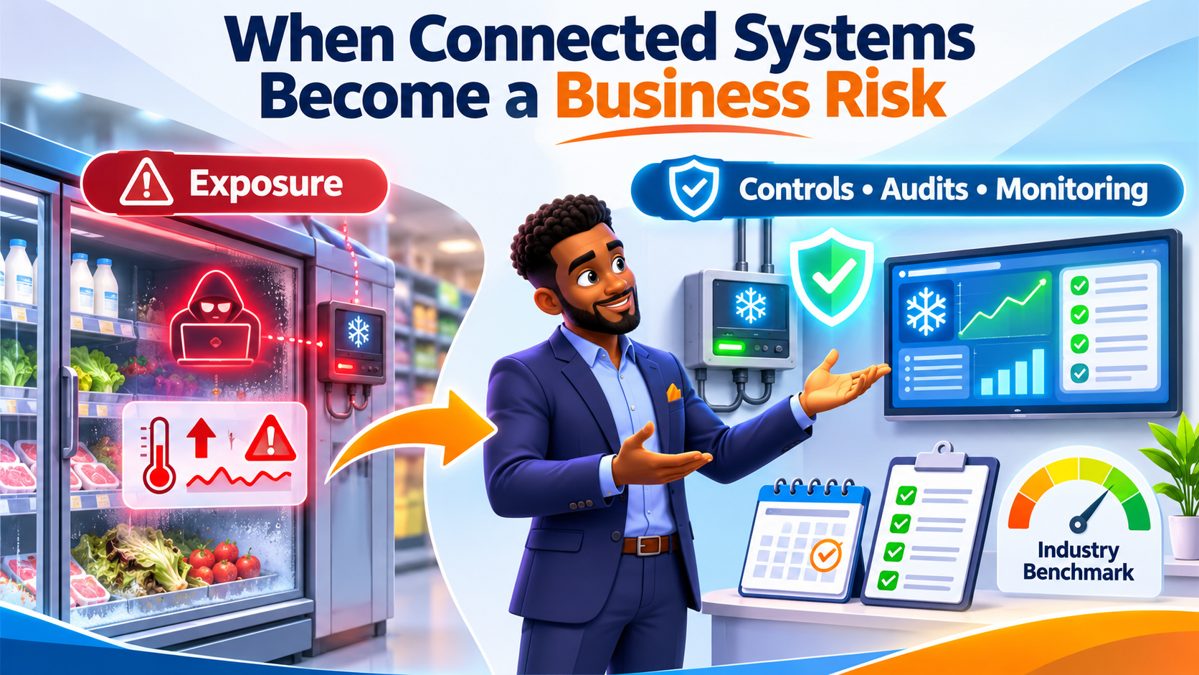
When attackers can change supermarket refrigeration settings remotely, cybersecurity becomes a direct operational and financial risk—not merely an IT issue.
On 1–2 November 2026, supermarkets and food businesses across several European countries reported interference with connected refrigeration systems. Retailers in Belgium, Sweden, Ireland and elsewhere experienced temperature spikes, resulting in discarded stock and disruption. A Swedish store reported freezers reaching 50°C. The incidents followed earlier attacks in France in October. The European Union Agency for Cybersecurity (ENISA) and European Commission confirmed multiple affected EU countries and called for urgent mitigation. Reuters' reporting describes the operational losses. Investigations continue; the incidents should not be treated as proof that every affected company lacked an audit programme.
From connected equipment to business exposure
Remote management of cooling systems improves oversight and efficiency, but internet-facing controllers, legacy software and poorly governed supplier access can create vulnerabilities. The same principle applies to ERP platforms, manufacturing systems, cloud applications and other connected operations.
The control question is not simply whether a policy exists. It is whether protective measures have been implemented, tested and monitored.
Control frameworks turn policy into evidence
The NIST Cybersecurity Framework 2.0 structures security around Govern, Identify, Protect, Detect, Respond and Recover. The CIS Critical Security Controls v8.1 offer practical safeguards including asset inventories, access controls and vulnerability management.
For an operational refrigeration network, this translates into identifying every connected device, restricting remote access, updating supported software, separating operational networks and verifying that independent temperature alerts and recovery procedures work.
A framework is only useful when it leads to measurable controls and clear ownership.
Why scheduled IT audits matter
A once-a-year review may miss changes made between audits. A risk-based assurance programme could include:
- Continuous: Monitoring temperature deviations, access anomalies and security alerts.
- Monthly: Checking vulnerabilities, patches and exposed systems.
- Quarterly: Reviewing privileged access, supplier connections and control exceptions.
- Annually: Independent assessment against a selected framework and testing business continuity.
- Following major changes: Targeted testing of new integrations, network configurations or software.
These are illustrative frequencies, not universal requirements; criticality and regulatory exposure should determine the actual schedule.
Benchmark against your industry—not just a checklist
A meaningful audit measures both control maturity and operational outcomes: coverage of known assets, overdue critical vulnerabilities, unauthorised access attempts, response times and recovery effectiveness. Benchmarking against appropriate standards and industry peers exposes gaps that routine system operation can conceal.
Bridging the cost and capability gap
Scheduled audits require time, specialist knowledge and evidence collection. Smaller teams may find this expensive. But removing assurance entirely does not remove the underlying business risk.
The practical response is right-sized assurance: automate repetitive evidence gathering, configuration checks, access reviews and alerts; then use qualified IT auditors and security professionals to test whether controls are genuinely effective and prioritise remediation.
The objective is not an audit for the sake of compliance. It is a demonstrably safer and more resilient operation.
References
- ENISA — Joint statement on refrigeration system cyber incidents, 4 November 2026
- Reuters — Cyberattack on supermarket refrigeration, 2 November 2026
- NIST — Cybersecurity Framework
- CIS — Critical Security Controls v8.1
.....................................